Ani Ma’amin (“I Believe”)


Dr. Maya Tevet Dayan has been awarded the First Lady of the State of Israel Prize for HaYehudia Hanodedet (“The Wandering Jewess”). Written while Tevet Dayan was abroad as war broke out in Israel, the collection explores the intersection of identity, history, religion, nationhood, and personal biography in the wake of the October 7 Hamas attacks and the war that followed, events that profoundly shifted the poet’s understanding of her own identity, as something she once believed she could set aside returned with unexpected force.
Presented at the President’s Residence in Jerusalem in partnership with Beit Avi Chai, the prize honors contemporary Hebrew poetry. Honorable mentions were awarded to Gal Nathan, Shlomi Hatuka, and Maor Tsabari, whose books likewise reflect the upheaval and complexity of recent Israeli life.

Established in 2018 by the late Nechama Rivlin, wife of former Israeli President Reuven Rivlin, the prize was created to encourage a new generation of Hebrew poets as Israel marked its 70th anniversary. Following Rivlin’s passing, the award was renamed in her memory. When the prize’s original funding came to an end this year, the Rohr family joined with the Office of the President and Beit Avi Chai to ensure its continuation, with the prize now also bearing the name of the late Jewish philanthropist Sami Rohr
“The world is willing to read beautiful poems”
Opening the ceremony, poet Amichai Chasson – artistic director of Beit Avi Chai and the prize’s first-ever laureate – reflected on the place of poetry in a world that often seems indifferent to it. He spoke of the gap between poetry’s enduring spiritual power and the material concerns that dominate everyday life.
For one evening, that indifference gave way: at the President’s Residence, Israel’s president and first lady set aside the demands of public life to celebrate Hebrew poetry. “For a brief hour,” Chasson said, “the world is willing to read beautiful poems, made of Hebrew words that have sustained us for thousands of years.”
First Lady Michal Herzog described poetry as an existential necessity. “These days it seems that poetry plays a life-sustaining, life-saving role,” she said. “Just as food, sleep, and shelter are necessary for the body, so poetry, art, and spirit are necessary for the soul.”
She noted that the trauma of recent years permeated many of the books submitted to the committee, and especially Tevet Dayan’s collection, which she said was written “almost out of necessity, under compulsion, out of a collision with something so bitter and heavy that it fell upon all of us.” The three honorable-mention winners, she added, likewise testify to poetry’s ability to confront reality and “find an opening even within the wound.”
When ordinary words fail, poetry speaks
Dr. David Rozenson, Executive Director of Beit Avi Chai, illustrated poetry’s unique power by recalling the wedding of former hostages Sapir Cohen and Sasha Troufanov, who attended the ceremony. At the wedding – attended by Rozenson alongside President Isaac Herzog and First Lady Michal Herzog – he felt that ordinary language was inadequate to express the magnitude of the moment. When language itself seemed to falter, the First Lady recited a poem by the celebrated Israeli poet Zelda (1914–1984), Yatzati El Mesos Hatan V’Kallah (“I Went Out to the Joy of Bride and Groom”).

“There are moments in the life of a people when only poetry can carry what prose cannot,” Rozenson said. “In that moment, the poem gave shape to what many of us felt; it gave voice to the grief of an entire nation, to its resilience, and perhaps above all, to its hope.”
Rozenson went on to describe poetry’s role in a fractured world. While poetry rarely changes history in a dramatic instant, he said, it performs something quieter and no less essential. It gives language to experiences that resist ordinary speech, preserves memory, expands our moral imagination, and reminds us that behind every public event lies a private human story, asking us to listen more deeply – to others and perhaps to ourselves.
He also described Hebrew poetry as one of the longest continuous creative conversations in the world, stretching from the Bible and liturgical poetry through Hayim Nahman Bialik (1873-1934) and Shaul Tchernichovsky (1875–1943) to today’s writers.
“The Hebrew language has survived for thousands of years not only because each generation inherited it, but also because each generation renewed it,” Rozenson said. “That is how a language remains alive. Today, we celebrate the poets who are writing its next chapter.”
George Rohr, representing the Rohr family, whose family supports the prize in memory of his father, Sami Rohr, observed that all winning books bear the imprint of war and the profound upheaval Israeli society has experienced. One of Hebrew culture’s enduring tasks, he said, is to give words to what has happened – and what continues to happen.
More than 250 poetry collections, from debut volumes to works by veteran poets representing diverse backgrounds across Israel, were submitted this year. The judging committee was chaired by poet and scholar Miron C. Izakson and included Anat Rivlin, daughter of Nechama and former President Reuven Rivlin; literary critic Shiri Lev-Ari; literature lecturer Bilha Ben-Eliyahu; and poet Amichai Chasson. First Lady Michal Herzog also took an active role in the selection process, reading the submissions, marking poems, and participating in the committee’s discussions. During the judging period, she recalled, her office became “a wonderful chaos of poetry books in every corner.”
Prof. Izakson reflected on the inseparable relationship between form and content in Hebrew poetry.
“Hebrew poetry, from the Torah, through Prophecy and the Writings, and the Middle Ages, to today’s cries and whispers, holds onto this wonder of content and form together,” he said.
Tevet Dayan’s work, he explained, combines deeply human and Jewish themes with poetic precision—exploring longing, sorrow, hope, humor, and self-examination.
The committee praised “The Wandering Jewess” as “a book about the desire to flee Jewish fate and the yearning to remain within it – about the search for a temporary home and the prayer that home will once again simply be home.”
It continued: “In her fourth book, Maya Tevet Dayan reaches an impressive poetic maturity. In a clear, precise voice she offers personal testimony to horror and to hope, in Hebrew that captures contemporary speech while remaining aware of the language’s historical and cultural layers.”
“Whoever has a president has a home”
Accepting the award, Tevet Dayan spoke movingly about her grandmother Rivka, who fled across Europe and spent years recounting those experiences to her granddaughter. Only after October 7 did she realize that those stories had never been merely memories or expressions of anxiety, but an “urgent mission”: “to pass on to me what she knew, and to make sure I understood and remembered: being a Jew in the world can be elusive, confusing, unpredictable, and hard to grasp. In hindsight, my grandmother spent her whole life preparing me for this moment.”
She also recalled her grandfather, a tailor in the kibbutz sewing workshop, who kept a photograph of Israel’s president on the wall. When she asked him why, he would simply reply : “If you have a president, you have a home.”
Reflecting on the meaning of home, she said:
“Home, for the wandering Jew, is never taken for granted. Thin as a newspaper clipping, you hold onto it the way you hold anything precious whose days are numbered – and certainly when this home is volatile, easily torn, one must guard it and its inhabitants all the more.”
Three more poetic responses to a turbulent reality
Three honorable mentions recognized books that, in different ways, grapple with the realities of contemporary Israel.
Shlomi Hatuka was honored for Nekudat Zechut LeRavakim (“One Point in Favor of the Bachelors”), which moves between urban life, the Lachish region in southern Israel, and communities along Israel’s border with Gaza, tracing the intersection of personal rupture and the national upheaval of October 7. The committee described it as “the brave work of a poet who dares to change, to find an independent voice, and to describe with compassion the complexity of life here.”
Gal Nathan received an honorable mention for Handasat Orot (“Light Engineering”). This collection shifts between the microscopic and the bird’s-eye view, illuminating hardship and distress alongside the beauty of the natural world. The committee wrote that her poetry “restores a sense of mutual responsibility and offers comfort among the shadows.”
Maor Tsabari was recognized for his debut poetry collection Nispach Tzava'I (“Military Attaché: Ramallah–Gaza, 2018–2024”), a deeply personal account drawn from his experience serving as both a fighter and commander. The committee highlighted the book’s portrayal of horror and muteness alongside love, parting, connection, and attentiveness, emphasizing its persistent search for the human and its insistence on closeness even within the inferno.
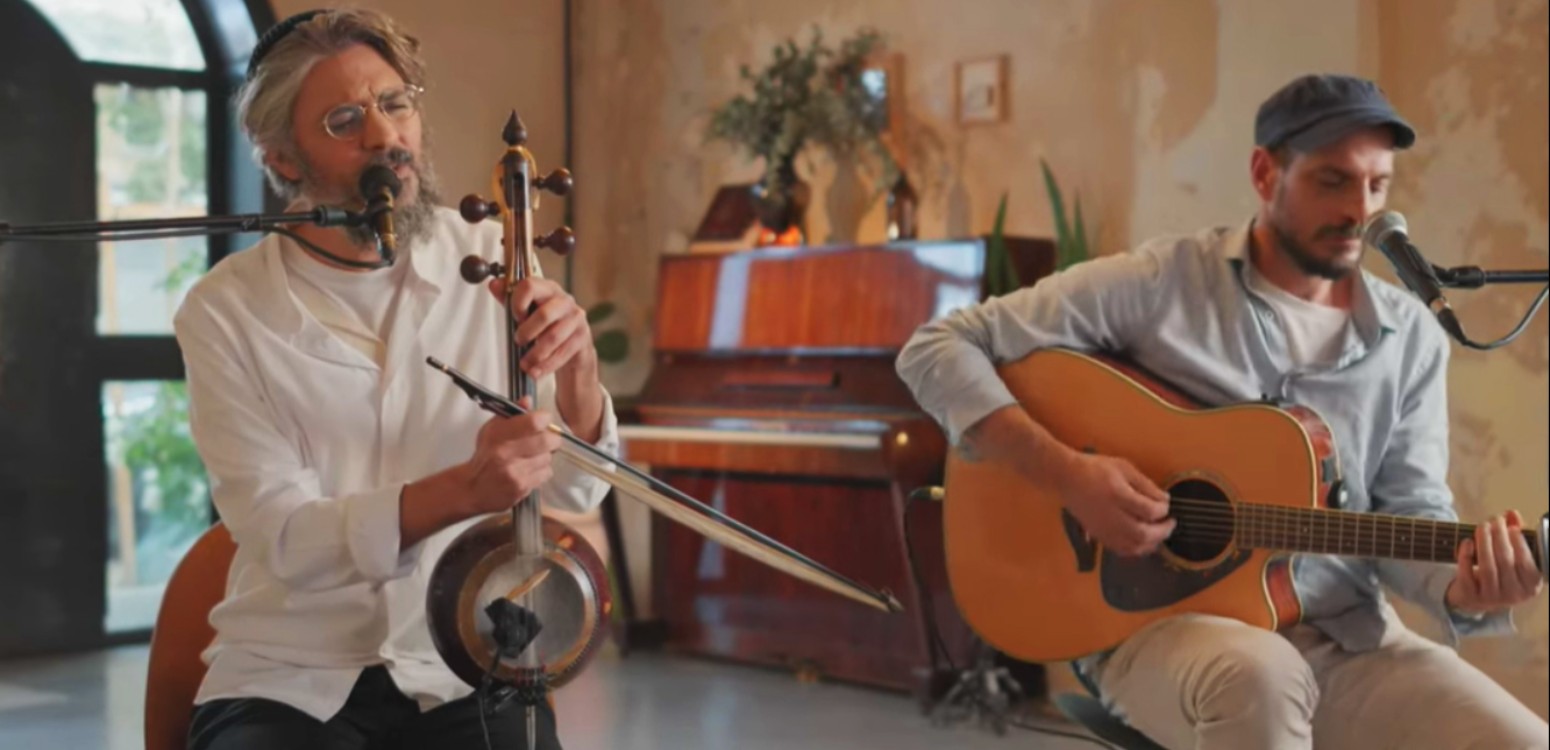
Between the readings and speeches, Jerusalem-born Djamchid Sisters performed a song by one of the most celebrated Hebrew poets of the modern era, Leah Goldberg (1911–1970), as well as one by the late Israeli singer-songwriter Meir Ariel (1942–1999), adding a musical dimension to an evening devoted to the power of Hebrew words.
President Isaac Herzog, First Lady Michal Herzog, Dr. David Rozenson, and George Rohr then presented the awards to Tevet Dayan and the three honorable-mention recipients.
Bringing the event to a close, Chasson returned to the podium to read one final poem by Tevet Dayan. Then the audience departed – back to the news, the war, and the uncertainties of everyday life – but perhaps with a renewed sense of why, especially at times like these, poetry matters.
This article was originally published in Hebrew.
Photos from the event: Nikolay Busygin