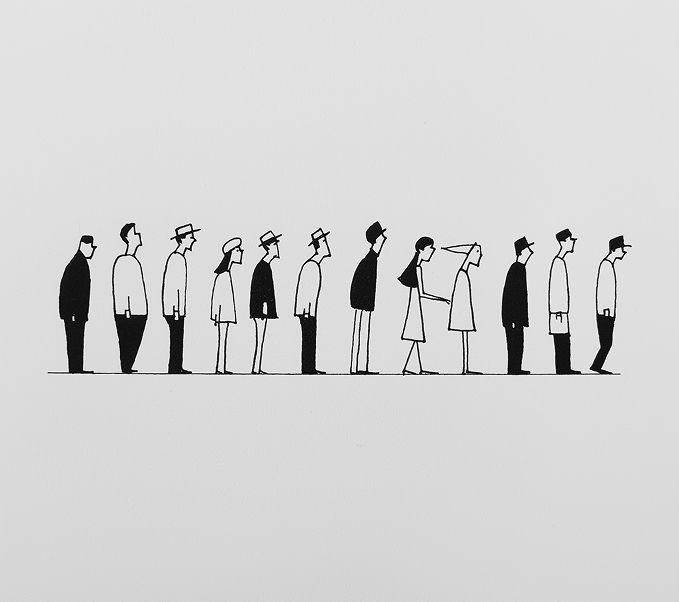
Ani Ma’amin (“I Believe”)


Laban’s sons begin to resent Jacob’s economic success, and Jacob senses a change in Laban’s manner. God tells him to return to the land of his fathers. Deeply afraid of how Laban will react, Jacob decides to slip away in secret. The Torah describes the moment: “Meanwhile Laban had gone to shear his sheep, and Rachel stole her father’s household idols. Jacob kept Laban the Aramean in the dark, not telling him that he was fleeing” (Genesis 31:19-20).
Rachel steals household idols, figurines believed to foretell the future, and Jacob steals Laban’s heart. What does it mean to steal someone’s heart? The German Orthodox rabbi Samson Raphael Hirsch (1808–1888) explained that it means winning another person’s goodwill without justification: through insincere friendship, or through good deeds performed without good intentions. Our Sages prohibit this under the term “stealing the mind.”
Stealing the mind
The Talmud states the principle plainly: one may not steal another person’s mind, and this prohibition extends even to a non-Jew (Chullin 94a). To illustrate this, the Gemara tells of Shmuel crossing a river by ferry. He asks his attendant to tip the ferryman fairly, and the attendant does, yet Shmuel is angry. Abaye explains that the attendant gave the ferryman a non-kosher chicken without saying so. At the time, a properly slaughtered chicken was known to be worth more, so the ferryman believed he had received a more valuable gift than he had. According to Rava, the attendant poured diluted wine into a vessel used for pure wine. In both versions, the deception is what upsets Shmuel: the attempt to make someone think more highly of me, and to feel more grateful to me, than I deserve.
A friend once told me he had invited an acquaintance for Friday night dinner on a night he knew the man would be away. “It’s a great system,” he said with a smile. “I earn points for the invitation, but I don’t have to cook or sit through a meal.” The Gemara in Chullin cites the sage Rabbi Meir offering this very example. Rabbi Meir adds others: giving gifts to someone who cannot accept them, or opening an expensive barrel of wine as though in honor of a guest, when it had to be opened anyway. Rashi captures the outcome in a single line: the one deceived is left grateful for a favor that never really happened.
We are constantly tempted to take credit we do not deserve. In relationships, we may want the other person to believe all is well while we are angry with them, or even speaking ill of them behind their back. The Gemara urges us to resist that temptation and not to steal another person’s mind and heart.
From theft to gaslighting
Today the term “gaslighting” is widespread, and the Academy of the Hebrew Language renders it in Hebrew as gezilat da’at, “robbing the mind.” One person causes another to doubt their own perceptions and their grasp of reality, often to the point of blaming themselves for what the gaslighter did. Gezilat da’at is the grave next stage of stealing the mind and the heart.
Rabbi Hirsch observes that Jacob too crossed this line, by never letting on, in word or gesture, that he had noticed Laban’s shifting attitude. Yet Rabbi Hirsch also recognizes that sometimes there is no alternative. Had Jacob revealed his awareness, Laban in anger might have sent him away empty-handed. In an extreme situation like this, stealing the mind may be permitted. The challenge is not to be drawn into it across a whole range of everyday situations.
Lior Tal Sadeh is an educator, writer, and author of “What Is Above, What Is Below” (Carmel, 2022). He hosts the daily “Source of Inspiration” podcast, produced by Beit Avi Chai.
For more insights into Parashat Vayetze, listen to “Source of Inspiration” (in Hebrew).
Translation of most Hebrew texts sourced from Sefaria.org
Main Photo: Jacob and Rachel at the Well\ Wikipedia