Ani Ma’amin (“I Believe”)


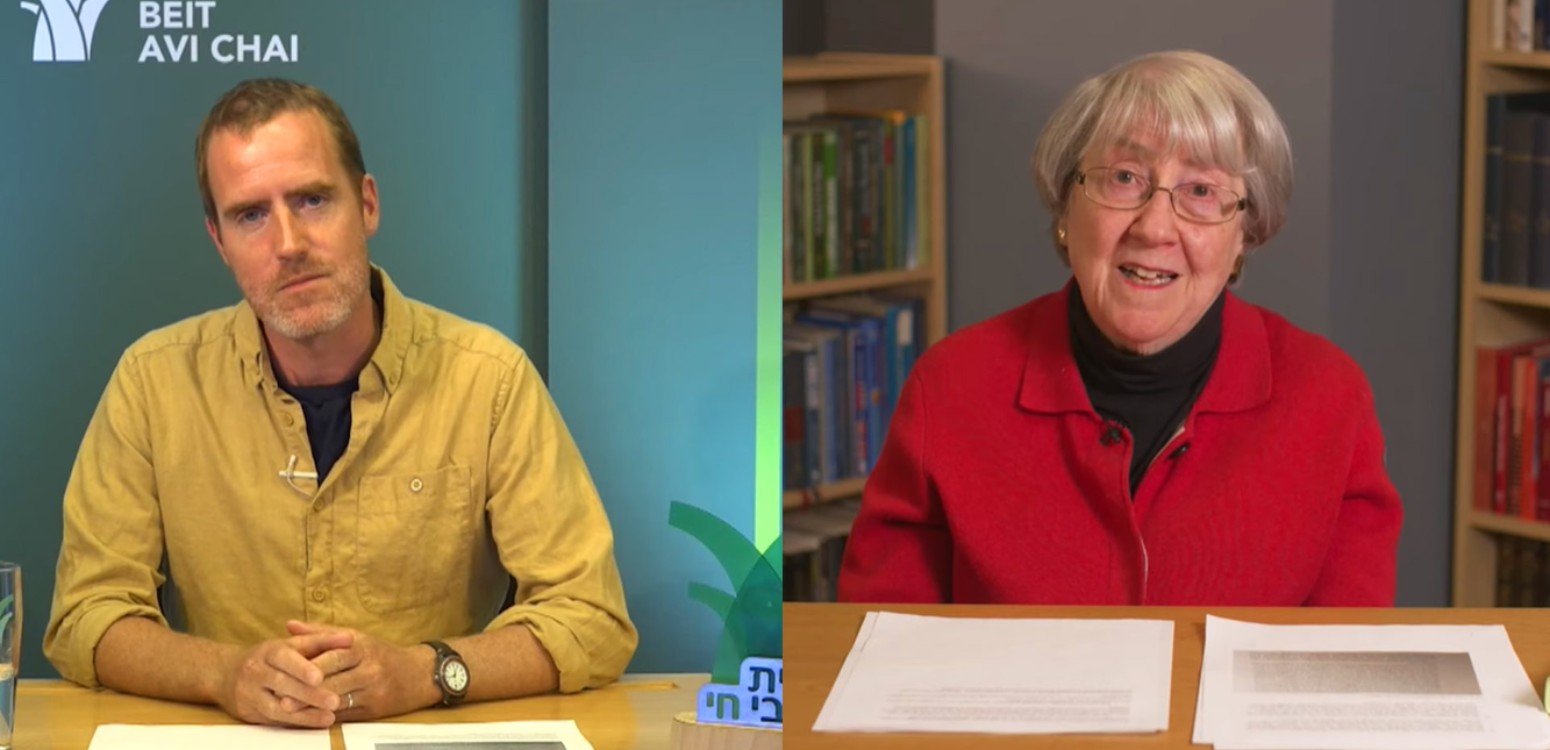
Jews and Christians hold in common texts like Genesis, Isaiah, the Psalms, and much else, but for centuries they have read those texts through a different lens. The interpretative traditions that surround them have diverged so dramatically that the same sentence can generate entirely incompatible meanings. Prof. Marc Zvi Brettler, a biblical scholar at Duke University and the Hebrew University of Jerusalem, has spent much of his recent career trying to understand why that happened, and what that divergence might teach both communities about themselves. His lecture series at Beit Avi Chai, “How Jews and Christians Read the Bible,” offers a rare look at this ancient rift.
Illuminating the logic of both traditions
Brettler is the ideal guide for this project. A scholar of the Hebrew Bible and an observant Jew, his deepest immersion in Christian readings of the Scripture came when he was asked to co-edit (with New Testament and Jewish Studies Professor Amy-Jill Levine) The Jewish Annotated New Testament, a landmark scholarly edition that brought Jewish commentary to bear on Christianity’s founding text. “The New Testament is ultimately a Jewish book written for a largely Jewish audience,” Brettler explains, “albeit one that doesn’t share beliefs we now consider to be distinctively Jewish.” Working on that project sharpened his sense that the barriers between these traditions are more permeable and more worthy of examination than many assume.
The series begins with the opening chapters of Genesis, moves through Psalm 22, selected prophecies of Isaiah, and ends with the Book of Jonah, all texts that have served as battlegrounds in the long history of Jewish-Christian polemics. Brettler, though, wants to approach them differently: not to declare a winner, but to illuminate the logic of each tradition on its own terms.
“Jews typically read the Tanakh through the lens of rabbinic literature,” he says, “while Christians read it through the New Testament.” This might sound obvious, but its implications are easy to underestimate. The reader’s interpretative context is so thoroughly internalized that readings that appear self-evident to one tradition can seem bizarre, or even wilfully distorted, to the other. One of the series’ central aims is to make these invisible lenses visible.
Genesis offers the first example. The Trinity and original sin – two of Christianity’s foundational doctrines – are traditionally located, at least in part, in the Bible’s opening three chapters. The phrase “let us make mankind in our image” in Genesis 1 is plural, and for early Christian readers, that plurality became evidence of a plural divine nature. Similarly, the phrase ruach Elohim in Genesis 1:2 – sometimes translated as “spirit (or Spirit) of God,” sometimes as “wind of God” or “great wind”– is ambiguous in Hebrew, and it was natural for early Christ-believers to identify that ruach with the Holy Spirit, the third element of the Trinity. “These are natural readings,” Brettler says, “depending on the context in which a person reads something.” Context, he stresses, is so determinative that readers are often unaware of it – “because it’s so obvious to us.”
Jewish interpretation of the same chapters is, by contrast, far more diffuse. Rabbinic tradition never settled on a single authoritative reading of Genesis 1-3 in the way Christian doctrine did, and the result is an exuberant, sometimes contradictory proliferation of meanings. Where Christianity coalesced around specific theological claims – the Fall, original sin, the Trinity – rabbinic commentary tended to multiply possibilities rather than narrow them. This contrast, Brettler suggests, is characteristic of a broader divergence: “Christian ways of reading the Bible are much more unified; Jewish ways are much more diffuse.”
Psalm 22 offers a different kind of case. The psalm’s opening verse – “My God, my God, why have you abandoned me?” – appears in two New Testament gospels as the last words of Jesus on the cross. For Christian readers, the entire psalm can be read as a prophetic text that anticipates the passion narrative. In some Jewish traditions, by contrast, the same psalm is associated with Purim, with Esther, or with Israel in exile. The two readings are not just different; historically, they were polemical. Jewish interpreters sometimes explicitly rejected the Christological reading; in turn, Christian interpreters could not understand why Jews refused the obvious connection. “Historically they polemicize against each other,” Brettler observes, “and it’s pretty clear that the Jewish tradition is sometimes explicitly reacting against the Christian connection of this psalm to Jesus.” But understanding that history of polemic, he suggests, is precisely what allows contemporary readers to step back from it. You can hold your own interpretation firmly while recognizing that the other tradition’s reading is not irrational but emerges from its own coherent context.
Different texts, different Bibles
The Isaiah session turns to perhaps the oldest and most charged of all Jewish-Christian biblical disputes. In Isaiah 7:14, the Hebrew text uses the word almah, meaning a young woman of marriageable age. In later Greek translation, the word becomes parthenos, meaning virgin. That Greek version, the Septuagint – translated by Jews – was the Bible that early Christians used, explaining why Matthew’s Gospel reads the verse as a prophecy of the Virgin Birth. For Jewish readers anchored in the Hebrew, the Greek translation already represents a deviation. “It’s important to understand that each community has a different Bible,” Brettler says, pointing out that the biblical text differs between traditions. The point is not to adjudicate between them but to understand that each reading is internally coherent according to the textual tradition it works from.
The Suffering Servant passages in Isaiah raise a related question. Scholars disagree about whether the “servant” refers to an individual, to Israel as a collective, or to some historical figure – past, present, or future – now lost to us. The text is, as Brettler puts it, “genuinely ambiguous.” Christian tradition has long read these passages as referring to Jesus; Jewish tradition has generally read them as referring to Israel or to a specific historical figure other than Jesus. Both readings are responses to a genuine textual puzzle, not exercises in motivated distortion.
The series ends with Jonah, an example of what Brettler calls a “magnet text” – a text so resonant, strange, and well-crafted that other texts are drawn toward it and meanings accumulate around it. Jonah is one of the Bible’s most enigmatic books – a reluctant prophet, a punishing storm, a great fish (no whale in the Hebrew!), a gourd that grows and withers in a day – and it is these qualities that have made it so open to interpretation. In Judaism, Jonah is the Haftorah reading for Yom Kippur, a text about repentance and divine mercy. In Christianity, the three days in the belly of the fish become a prefiguration of the Resurrection, with Jesus explicitly identifying himself as a Jonah-like figure in Matthew and Luke. “Given the importance of that motif within Christianity,” Brettler says, “it’s easy to see how that particular aspect made it so attractive to them.”
A window into first-century Judaism
Working on The Jewish Annotated New Testament, Brettler came to understand Christian interpretations of the Bible more deeply. “Many Jews find it hard to understand Christian interpretations,” he says, “but if they look closely, they will see that some Christian interpretations are no less far-fetched than some Jewish ones.”
For Israeli audiences in particular, there is a specific gap to bridge. Most have never read the New Testament – it is not part of the curriculum, and it carries complicated historical associations as a result of Christian persecution of Jews. But, Brettler argues, the New Testament is one of the most important windows we have into first-century Judaism, the world out of which both Christianity and rabbinic Judaism emerged. “Appreciating how someone else understands the text differently does not in any way take away from your beliefs about the text,” Brettler says. “I know that idea sounds simple, but for many people it is not.” The goal is for people to recognize how the same words, in different hands, open onto different worlds, each with their own wisdom to share.
Main Photo: AI