Ani Ma’amin (“I Believe”)


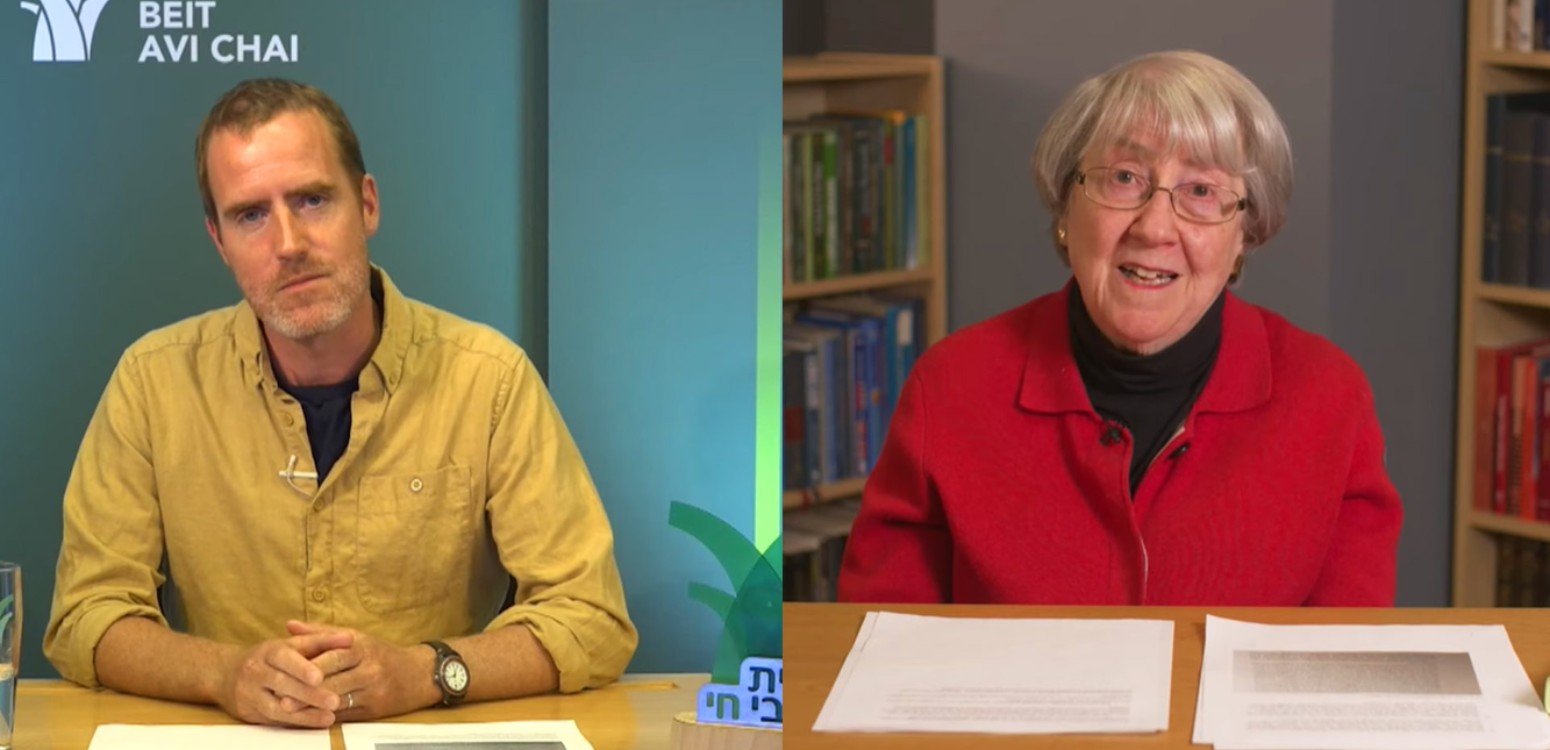
When Léon Askénazi (1922–1996) – known more commonly as Manitou (the word, which means “Great Spirit,” comes from indigenous North American mythology; Askénazi acquired the nickname whilst in the Scouts) – spoke about fraternity, he wasn’t just talking about getting along. For him, the question of how siblings relate to one another was the central moral problem of human existence, one that began with creation itself and extended through biblical narratives, Jewish history, and into the contemporary world. For Dr Joëlle Hansel, whose lecture series at Beit Avi Chai explores Manitou’s thought, understanding this “equation of fraternity” is key to grasping both his intellectual significance and enduring relevance.
According to Hansel, who earned her PhD in philosophy from the Sorbonne and has taught at the Hebrew University of Jerusalem and the Collège international de philosophie in Paris, Manitou read the entire arc of Jewish history through the lens of “mutations of identity” and the struggle to create space for the other. He sought to rehabilitate Jewish texts as living sources of thought and to address what he saw as the messianic project of establishing a collective identity in the State of Israel.
The revival of Jewish thought in post-Shoah France
Hansel’s connection to Manitou is both intellectual and personal. “My background is in philosophy, and my education is French,” she explains. But her interest in Manitou began before her academic career. Like Manitou, Handel’s mother was born in the Algerian city of Oran, and he had been her youth leader in the Scouts. “I was looking for meaningful thinkers. I found this in Manitou, and also in Levinas.”
The pairing of Manitou and Emmanuel Levinas (1906–1995) is quite common. Both were central figures in what Hansel calls “the revival of Jewish thought in post-Shoah France,” a movement dedicated to showing that Jewish texts are not merely objects of piety or nostalgia, but genuine sources of meaning. Yet their approach diverged in crucial ways, particularly around the question that obsessed Manitou: How do we make room for the other?
.jpg)
Both Hebrew and Israeli
During the immediate post-war period, Manitou underwent what he saw as a mutation: a return to becoming an Ivri – a Hebrew. This wasn’t just a semantic shift. For Manitou, it reflected a fundamental transformation in his identity, one that accelerated after 1967 with his aliyah to Israel. “After 1967, this process reaches a new stage: Manitou now understood himself as both Hebrew and Israeli,” Hansel explains. This personal journey mirrored his reading of Jewish history itself: Abraham was originally ha-Ivri, the Hebrew; with the destruction of the First Temple and exile, Ivri became “Jewish”; now, with the creation of the State of Israel, it became possible to be Hebrew again – and, for the first time, Israeli.
The beginning of the Geulah
Manitou’s teacher was Jacob Gordin (1896-1947). A scholar who had written his PhD on the German-Jewish philosopher Hermann Cohen (1842–1918), he formulated a principle that would guide the entire post-war French school of Jewish thought: “The questions are universal, but the answers are Jewish.” For Manitou, Hansel explains, this meant that Jewish sources “weren’t parochial texts but living resources for addressing fundamental human questions.”
Gordin taught Manitou the concept of “historiosophy.” This was taken from XIX century German philosophy – understanding history not as a mere succession of events but as having a finality and direction of its own. Manitou developed this into his notion of toladot, a term drawn from the Bible which means “engenderments.” History, as described in the Jewish canon, has a goal: the messianic establishment of a society in which each person makes room for the other. This requires achieving klal – a collective identity, a unification of the Jewish people. Manitou eventually came to realize that this could only take place in the State of Israel, which he saw, following in the footsteps of Rav Kook (1865–1935) and his son Rav Tzvi Yehuda Kook (1891–1982), as marking the beginning of Geulah, the redemption.
A meeting with Rav Tzvi Yehuda Kook in the 1950s crystallized Manitou’s Zionism. “My father-in-law, who was Manitou’s student, was there,” Hansel recounts. “They spoke for hours and there was a shift in Manitou’s thought. This was on his first visit to Israel.” From this point onward, Manitou became convinced that Jewish collective existence required political sovereignty.
Fraternity cannot be taken for granted
The notion of “Enemy Brothers” is also crucial. For Hansel, this goes to the heart of Manitou’s thought: the problem of fraternity as it appears in Biblical sibling narratives like Cain and Abel. “For Manitou, history begins with Cain and Abel, because this is where the moral problem of making room for the other first emerges.” For Manitou, creation itself was already a moral act. Drawing from Kabbalah, he described it as an act of tzimtzum, the divine contraction that made room for creatures. “Just as God contracted his infinity to allow creation, humans must make room for one another,” Hansel explains.
What makes Manitou’s reading distinctive is his refusal to view Cain as the only one responsible for the failure of fraternity. “Usually, we begin with Cain as a murderer,” Hansel notes. “But Manitou would say that Abel is also responsible. He failed to teach Cain how to be a brother. This is a very original approach.” Abel couldn’t solve the equation of fraternity. “It’s not a Manichean tale of good and evil,” Hansel emphasizes.
This pattern repeats itself throughout the Book of Genesis: Isaac and Ishmael, Jacob and Esau, and more. In Hansel’s words, there is “a succession of failures.” In each case, Manitou examines the responsibility of both parties, trying to understand why fraternity repeatedly breaks down and what tikkun (“repair”) might look like.
This motif culminates with the story of Joseph and his brothers. When Joseph’s brothers come to Egypt during the famine, they find that he has become a powerful political figure. Manitou interprets Joseph as representing political power in exile, “in the service of the nations,” while Judah and his brothers symbolize the return to Eretz Yisrael. For the first time in the fraternal narratives of Genesis, recognition and reconciliation become possible. “Fraternity cannot be taken for granted,” Hansel warns.
A shared, mutual bond
Manitou also examined the relationship between man and woman. With Adam and Eve, he saw an elevation from purely biological reproduction to a human relationship with the other. But with Abraham and Sarah, a further mutation occurs. “Abraham and Sarah established a brother-sister relationship, one of dialogue,” Hansel explains. This dialogue must be mutual and reciprocal. When Abraham tells Sarah to say she is his sister (so that she would be treated well), she responds by calling Abraham her brother. “For Manitou this is paradigmatic,” Hansel concludes.
It’s here that Manitou’s differences with Levinas become clear. “For Levinas the relationship with the other is asymmetric,” Hansel explains. Levinas emphasized infinite responsibility for the other without expecting reciprocity. “Manitou, by contrast, insists on reciprocity. Fraternity requires that each makes room for the other, but within a shared, mutual bond.” This wasn’t a minor theoretical disagreement but reflected the two thinkers’ fundamentally different visions of living ethically.
Relevant for contemporary Israel
Manitou’s thought is particularly relevant for contemporary Israel. “It’s very important to heal our fractures in Israel,” Hansel says. “What Manitou says about the klal is very meaningful.” Though his audience was initially French-speaking, in recent decades his work has found wider resonance. He began teaching in Hebrew, and “now he is widely studied and well known in universities and among the general Israeli public.”
The issues Manitou traced from Cain and Abel through Jewish history to modern Israel remain unresolved. The equation of fraternity, as he understood it, still awaits its solution. But in Hansel’s careful exploration of his thought, we see both the difficulty of the problem and the resources Jewish tradition provides for addressing it, as open questions that continue to demand our attention.
“What he said is very universal,” Hansel argues. In a world still struggling with how to make room for the other, Manitou’s voice – which emerged from the specific experience of French Jewry after the Shoah and crystallized in his embrace of a collective existence in Israel – speaks to challenges that transcend any single community. The space he occupied, between traditional Jewish sources and contemporary philosophy, between France and Israel, between being Jewish and Hebrew, remains a productive space for contemplating the moral problems that define our era.
Fore more, see Dr. Joëlle Hansel’s series on Léon Askénazi (Manitou), in Hebrew.
Main Photo: Léon Ashkenazi\ Wikipedia