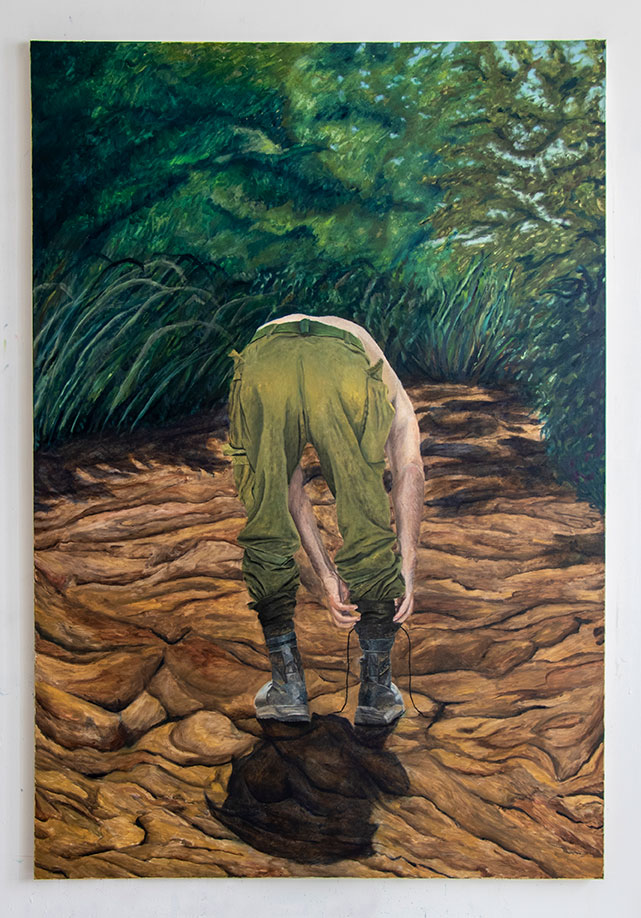
Nameless Soldier, 220x150 cm. Oil on canvas\ Elkana Levi
Portrait of the Artist as a Reserve Soldier
The realistic, figurative oil paintings of Elkana Levi (b. 1993) began in a sketchbook he carried with him through repeated rounds of reserve duty. From the first days of the fighting—when he was deployed to the northern border as a self-propelled artillery commander—these drawings gradually developed into large-scale oil paintings, produced in his Jerusalem studio during brief intervals between deployments. The slow, deliberate work in oil became a means of psychological processing: a way to contend with the constant tension and compressed time of the battlefield.
Levi depicts himself as a soldier even after returning home. In Noah’s Ark, he appears still in uniform as his young daughter sits on his lap; a toy rests in one hand, a paintbrush in the other, while his thoughts seem anchored elsewhere, preoccupied with scenes of combat. In another self-portrait—echoing the tradition of Renaissance painterly self-representation—the military uniform replaces the artist’s robe, and a weapon hanging on the wall stands in for the absent brush. Even still life is drawn into this reckoning: folded uniforms packed in a bag substitute for the traditional bowl of fruit or bouquet of flowers.
Throughout the history of Israeli art, portraits of soldiers have undergone repeated transformations—from idealized images of heroism in the state’s early years, through protest and the dismantling of the ethos in the 1970s and 1980s, to postmodern and kitsch treatments in the 2000s. Levi’s work captures a more fragile condition: the unresolved tension between hero and anti-hero, coexisting within the same figure.
Elkana Levi (b. 1993) is a graduate of the Pardes School of Art and the Hamidrasha School of Art, from which he graduated with highest honors. He lives in Jerusalem and works at the Talpiot Artists’ Studios.